It may seem strange, but explaining how the extrusion of plastics takes place is possible through images… Culinary! What? Anyone will have happened to follow a recipe that involves mixing water and flour. Perhaps, to share a pizza with friends; to celebrate a birthday with a cake; to bake fragrant Christmas cookies. All these foods, in fact, have one thing in common: the mixing of ingredients of different nature. If you have landed between the lines of our articles for the first time, we invite you to first read the first episode that explains what masterbatches are. For those who already follow us (and for the rebels who do not want to submit to the rules), put on your aprons and get ready to get your hands dirty with flour and pigments.
The art of handmade dough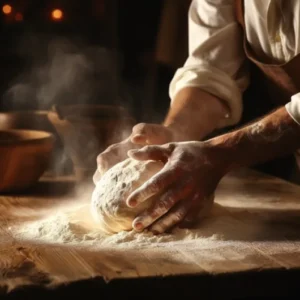
Kneading by hand is an art that contains a meaning of love. It is giving energy and effort for those with whom we will share the meal. A gift that has a purpose: the longer the mixture is kneaded, the better the quality of the bread. It is kneaded by hand to heat the mixture and let the gluten out of the mixture through the heat of the friction. When you do this for less than ten minutes, the temperature of your hands is not enough to heat the dough. It is a long process. Letting the gluten out is used to incorporate the air which, by forming bubbles inside the mixture, will make the bread soft. Without this air, the result will be hard and difficult to chew. The same principle applies to the extrusion of plastic in mechanical dispersion.
Plastic extrusion: how is it done?
Each polymer, or each type of plastic, needs to be brought to the right temperature in order to reach a viscosity that allows it to be processed. In general, in order to heat it, it must be mechanically “kneaded”, through a friction movement, or rubbing. In physics, in technical language, we speak of /shear rate/, or shear stress. The continuous rubbing produces a deformation and an increase in temperature that leads the plastic to a change of state from solid granules to viscous mass. This happens in particular machines, called extruders, in which one or more screws, rotating, push the plastic against the walls of the machine itself. This stress leads to an increase in temperature of the material which “melts”. Then, the movement of the screws transports it out. In the outlet, the plastic gets the desired shape that depends on the shape of the extruder nozzle. The last stage of plastic extrusion is cooling in water or air.
Each polymer has its own extrusion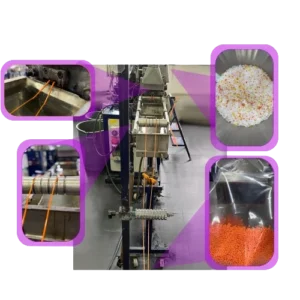
The masterbatch can have different types of polymer bases, so each formulation needs a dedicated extrusion. This is because each composition has a different viscosity. It is like comparing the dough of a common bread composed of water and flour, with an Indian bread made of flour and yogurt, where both require specific, albeit conceptually similar, amalgam processes. Similarly, plastic extrusion is also generally similar, but can comprise distinct modes. You need to know all the ingredients of the recipe well to know how to work them correctly. This is because the masterbatch granule is similar to a spacecraft containing pigments and additives ready to be released. It is precisely the rubbing process that we have described, also called mechanical dispersion, that allows the various types of capsules to open and release their contents.
Why do plastic extrusion with mechanical dispersion?
Now, both in the art of dough and in the extrusion of plastics, lumps must not form in the mixture. In bread, agglomerates are mostly packaged flour, in plastic they are pigment crystals stuck together that are encapsulated in molten plastic. Mechanical dispersion well performed consists of breaking up these clusters, passing molten plastic between the fractures, during the separation phase of the fragments. In this way, they are “wet” to prevent them from sticking again. A bit like water added to a flour compress to dissolve it. This is why mechanical extrusion is so important: since the coloring strength of a product is determined by its ability to cover a surface available to light, if there are lumps there is less availability, because the clumps prevent a homogeneous dispersion of pigments . After all, even a lumpy loaf cannot be tasty.
What are masterbatches, plastics, and other questions
Still doubts? Write to us, we are here to answer your curiosity!