
Pigments for plastics
Customized solutions for the coloring of plastics
Anyone who works in the world of plastics knows perfectly well that color is much more than just an aesthetic choice. It consists, in fact, of a fundamental element that defines the identity of a product, influences its perception in the market and consumers and, in many cases, even determines its functionality. Precisely because we deeply understand the importance of coloring plastics, we at Gaypa offer you cutting-edge solutions based on the strategic use of pigments, capable of creating unique and high-performance creations. In addition to choosing the right pigment, which is essential not only for aesthetic and marketing reasons, there is also the possibility of incorporating additives that give specific technical properties, expanding the functionality of the final product.
What are pigments for plastics?
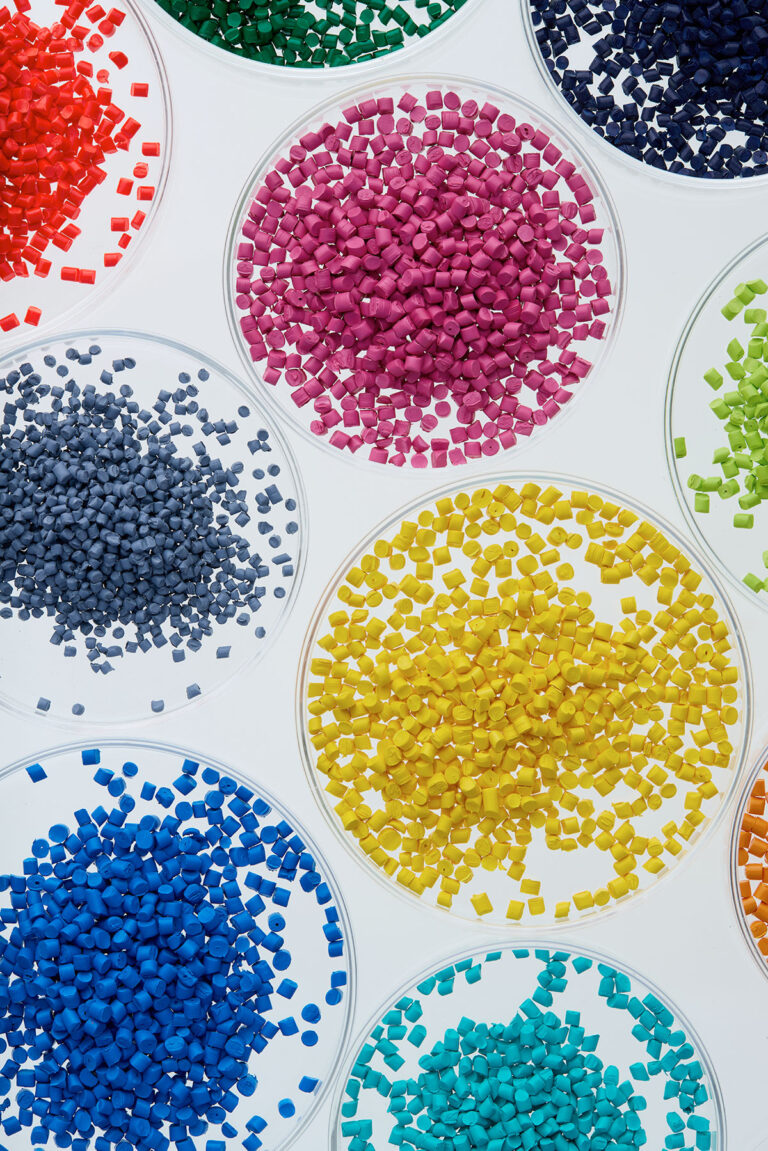
At the heart of the coloring of plastics we find pigments: these are substances capable of giving the desired color to the material in which they are incorporated. The pigments remain dispersed in the polymer as solid particles, providing color through the absorption and reflection of light. This makes them ideal for obtaining matte, bright colors with a high covering power.
Pigments for plastics are differentiated into organic pigments and inorganic pigments and their main difference lies in the presence of carbon atoms within the molecules that compose them. Organic pigments, in ancient times, were extracted from plant raw materials composed of carbon, such as plant roots and bark of trees, flowers, or from animal derivatives such as squid ink and murex purple. In the modern economy, however, things have changed a bit and all these pigments are now synthesized directly in the laboratory, especially organic pigments, for an economic and ethical reason.
In contrast, inorganic pigments were extracted from minerals, such as rocks, limestone, topsoil, and metals; just think of the red of iron oxide or the blue of lapis lazuli. Again, the modern trend is aiming at their synthetic production to control their quality and availability.
Understanding this distinction is critical, as the properties of these two large groups directly affect the performance and applications of colored products.
Contact us for personalized advice
Properties of pigments for plastics
The choice of pigment for plastics is never random: it depends on the properties you want to give to the final product and the conditions to which it will be subjected. The different composition of the molecules of an organic element compared to an inorganic one also involves different properties, which must be carefully considered in each formulation:
- Intensity and brilliance: Organic pigments are known for their higher brilliance and higher color intensity, which allows you to achieve vivid and saturated colors even with lower dosages. This makes them perfect for all those products that need to have a strong visual impact (as in the case of cosmetic packaging);
- resistance to light, water and heat: inorganic pigments demonstrate better resistance to light, water and heat; they are less flashy than their organic “cousins”, but definitely more stable. In contrast, organic pigments are more “delicate” and susceptible to exposure to bad weather and light;
- Thermal stability: Resistance to high temperatures is essential in the plastic transformation process. Organic pigments, for example, are at greater risk of “burning” or degrading if exposed to high temperatures for a long time, so it is preferable to opt for inorganic pigments in production processes at high temperatures;
- Color migration: The phenomenon of color migration, i.e. the tendency of the pigment to move from the inside of the polymer matrix and stain adjacent surfaces (another layer of plastic, for example), is significantly lower in inorganic pigments. Organic pigments, on the other hand, have a greater tendency to migrate and, for this reason, the choice is essential for applications where maximum color stability is required, such as in multilayer packaging and food contact;
- opacity and hiding power: pigments give opacity and hiding power to the plastic material. This is particularly important for products that must not be transparent or that must completely cover the substrate underneath, for example to protect the contents from light infiltration;
- Polymer compatibility: It is very important that the pigment is compatible with the base polymer (PE, PP, PET, ABS, etc.) to ensure optimal dispersion and maintain the physical properties of the material.
To get the best out of the two types, or to add strength and durability to organic pigments, we at Gaypa can combine them with each other or integrate additives intended for color preservation; This allows us to provide you with tailor-made solutions that combine brilliance and stability and correctly meet the needs of your application market.
How pigments are used in plastics
- Masterbatch: a concentrate of pigments (and/or additives) dispersed in a carrier polymer, which facilitates their incorporation into different resins and is used in small percentages of use. Generally, the masterbatch is the ideal choice when there are many color changes, or the need for customized shades and relatively short production runs (still at an industrial level) emerges. It offers numerous advantages in terms of cleaning, ease of dosing and a much higher color dispersion than other methods, reducing production errors;
- Dry blending (powders): this method consists of directly mixing powdered pigments with plastic resin before processing. Its main advantage is the lower initial cost, since the masterbatch production step is eliminated; However, the disadvantages are significant: powder handling can create dirt in the work environment, color dispersion is often insufficient, leading to uneven results, and is more difficult to dose accurately, increasing the risk of manufacturing errors and unwanted color variations;
- liquid pigments: similar to powder pigments, the use of liquid pigments also presents critical issues. The pigment is “free” in the liquid vehicle and not “inert” within a resin as is the case with the masterbatch, making it more difficult to manage and potentially dirtier. In addition, the efficiency in terms of color dispersion can be lower and compatibility with different resins is not always guaranteed;
- Compound: The difference between compound and masterbatch lies mainly in the production process and the intended use. The masterbatch, as already seen, is a concentrate of pigments and/or additives in a carrier polymer and is used in the final production formula in small percentages of use to color and/or add to plastics and specific materials; The compound, on the other hand, is a ready-to-use formulation, containing various components such as the base resin, all the necessary additives and any pigments. It is, in essence, a mix of several materials used for direct production and, usually, works well with few color changes and large-scale industrial production. It should also be noted that a compound can also contain masterbatches inside.
Frequently asked questions about plastic pigments
Pigments for industrial use were born, in principle, for inks; In the development phase, then, some pigments are specially treated and formulated to be used in plastics as well. The list is vast and we at Gaypa select only the most suitable and performing ones for each specific application.
Polypropylene (PP) is a very versatile and widely used resin. For its coloring, it is essential to use pigments that are resistant to high temperatures, generally above 200°C. Our expertise allows us to select pigments that guarantee stability and brilliance even in these conditions.
Yes, pigments can affect the mechanical properties of plastics, particularly in semi-crystalline or crystalline plastics, and especially if organic pigments are used. To curb the problem, we at Gaypa take advantage of the addition of additives called nucleating agents: these are chemical compounds that affect the crystallization of plastics, acting as “crystallization germs” within the material, providing anchoring sites for molecules and allowing them to facilitate the formation of a neater and more compact crystal structure. As a result, the plastic becomes less susceptible to warping and stress during cooling
The most common method of measuring the lightfastness of a pigment is the Blue Wool scale. Each pigment has a value ranging from 1 to 8, indicating the fastness of the color to light: 1 is the resistance of a color that fades as soon as it is exposed outdoors, while 8 is the fastness of a pigment that, left in the open air, is still intact after years of exposure.
Yes, with a view to greater sustainability, there are pigments that can be considered biodegradable or eco-friendly. Some naturally derived pigments, mainly organic, are inherently more eco-friendly and, if certified, can be used (with specific percentages of use) within biodegradable materials.

Contact us for personalized advice
The world of plastic pigments is vast and complex and, in many cases, it can be really difficult to find the solution that best suits your needs. Through our expertise, we at Gaypa are able to offer you tailor-made coloring solutions, designed for your specific needs. Whether it’s achieving a unique shade, ensuring resistance in extreme conditions or finding eco-friendly solutions, our team of experts is ready to listen and guide you in choosing the most suitable pigments and masterbatches.
Contact us for personalized advice!