Have you ever compared identical production pieces, but made at two different times, and found that the color is completely different? Have you ever seen two items, produced with the same raw materials, have a high color delta , without being able to explain why? Quiet. It happens even to the best. We’ll let you in on the secret. Usually, in order to start industrial production, you first need a starting sample . In the case of the world of plastic processing, laboratory staff is responsible for analyzing this sample and identifying the color that characterizes it. Once you have studied a formula to reproduce the piece on a larger scale, you can proceed. Then, the Quality department verifies that the item made is as faithful as possible to the primary sample. As for the color, you have to make sure that the mix of pigments chosen has worked well obtaining a shade like the original.
What is delta color?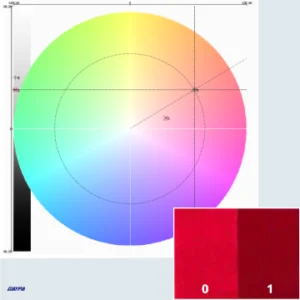
The difference between the colors can be calculated and its unit of measurement is the delta color (Delta-E): the larger this indicator, the greater the difference between the shades, or what is defined as “color distance”. Obviously, in industrial production, there is a tolerance limit because it is really difficult to reproduce a color perfectly, in fact certain differences are almost imperceptible to the naked eye. But then, why can it happen that between different batches of the same product there are great differences in nuance compared to the original sample? How does the chromatic alteration occur when the same raw materials are used?
On the right, simplified comparison of two red plates. From the graph you can see two values: chiaroscuro and hue. Sample number 0 has a lighter and more orangeish color, while sample number 1 has a darker color tending to magenta. To illustrate the concept visually, we chose two samples with a very high Delta-E of more than 30. Usually, a laboratory works on delta color values even lower than 1.
Delta color and pigments: a matter of dispersion
The color of a plastic object depends on how many and which pigments are dispersed on its surface. Differences in the concentration (i.e., quantity) of the pigments present can result in different shades and, consequently, a high delta color. Any mixture, in order to stay in balance, needs each ingredient to be added only up to a certain limit, i.e. a maximum concentration. For example, if we mix a lot of flour with a little water, it will be impossible to make a good dough to make bread. The same concept also applies to pigments and additives to be combined with polymers. In fact, optimal dispersion is difficult to achieve at high concentrations. One of the modern technological drives is precisely to be able to generate more and more concentrated masterbatches. The greater the amount of pigment present, the more coloring strength the product will have.
Color Makers and Smart Pizza Makers
Unfortunately, the path of quality and innovation is not the same as the way of ease. Today it happens more and more often to find diluted masterbatches instead of concentrates, just like pizzas made with an excess of water: deformed, tasteless and so thin that by lifting the slice all the seasoning falls on the plate. Personally, when mozzarella and tomato slip away and only a piece of wet dough remains, I find it a real misfortune. You can’t expect to get a tasty pizza if you economize too much in its composition. The problem is that many pizza makers have become clever: they reduce the ingredients little by little, “the customer doesn’t notice anyway.” We start by lowering the amount of flour, then mozzarella, then the size of the dough… These are changes that are not immediately noticed, especially when they take place over a long period of time. But in the end you realize that something is wrong, because you end the dinner still hungry.
The chromatic drift
Unfortunately, this also happens with colors. Lowering the concentration of the product offered means obtaining a mediocre final result. You don’t notice it immediately, because noticing certain differences in the nuances of the same tone is practically impossible for a non-expert eye. And so, in the long run, the color of an article begins to degrade due to imperceptible variations. Chromatic drift is defined as the faint but constant color alteration over time, which in the long term causes enormous variations in the delta color unit. This is where masterbatch manufacturers come in. The ability of the expert master’s student is to be able to produce items that are always the same, to prevent and prevent alterations, guaranteeing the customer the supply of identical products over time with constant concentration. No unwelcome surprises. Like the mom who gives your old toys to her little cousin, because you didn’t use them anymore, so you wouldn’t even have noticed. And instead you realized it very much.
Chromatic alterations over time
Sometimes the chromatic drift is not intentional, it just happens. The reasons can be countless: change of raw material suppliers, slight production errors, alteration of quality control machinery, turnover of personnel… But in the end the question always remains the same: you find yourself, perhaps after years, with a printed product and compared with the original sample, recovered by chance from the shelves of the warehouse. Just then it turns out that, alas, the items in comparison are of two completely different colors. Is it possible that no one has noticed such a high delta color before? Yet, the machinery to verify that the parts are within the tolerance limit exists!
Earthquakes, volcanoes and chromatic alterations
In this case, to explain what happened, we resort to geology: the sudden eruption of a volcano is very newsworthy, with large shaking of the ground, fractures of the ground, lava flows and ashes scattered for hundreds of kilometers. But no one pays particular attention to the short and imperceptible movements of the earth, perhaps underwater, which cause very slight oscillations every day. Yet, it is precisely these almost daily micro earthquakes, constant but imperceptible, that move the continents. Thus a great production error is much more evident, but absurdly less drastic, than a slow but progressive change.
That is, comparing a batch only with another previous one and not with the original sample, increases the margin of error that is within the tolerance. This is because the point of reference is no longer the one established in the beginning, but one realized at a later or third time. As we said, it is almost impossible to produce two colors in a perfectly equal way, so the new sample already contains a percentage of delta color alteration that can only increase from production to production.
Problems with color management?
Did you just find out you have an earthquake going on in production? Write!