
Colouring of plastics
Tailor-made solutions for every need
The coloring of plastics plays a role of primary importance in the contemporary industrial landscape and goes far beyond simple aesthetics. It represents, in fact, a fundamental distinctive element for the marketing and presentation of the product, capable of influencing the perception of the consumer and helping to define the visual identity.
Be careful, however, because coloring is not just appearance, on the contrary: taking into account the peculiar physical characteristics of each pigment, the use of specific dyes in synergy with the chemistry of the target material makes it possible to integrate additional functions to plastic, adapting it to application in various sectors.
A concrete example is our Litescreen line, where pigmentation plays a fundamental technical role in shielding light waves and making containers more effective in protecting their contents, even managing to extend the shelf life of perishable materials such as dairy products and medicines.
Furthermore, using the right pigments can improve waste circularity, as in the case of our NIR line, formulated with special pigments capable of optimizing the automatic recycling process.
Plastics coloring technologies
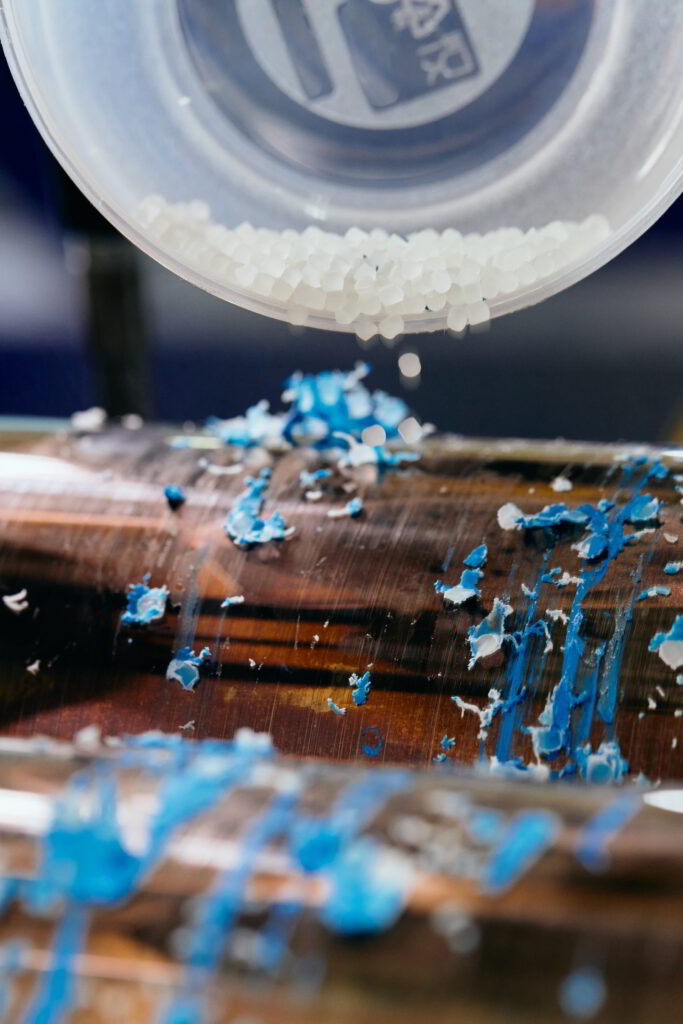
- masterbatch: The main method of coloring plastics, consist of pigment concentrates and additives dispersed in a carrier polymer. They offer superior color dispersion, increased chemical and thermal stability, ease of use, and customization for specific applications;
- pure pigments (powders): the direct use of powdered pigments may initially appear cheaper; however, powder handling can cause more contamination in the work environment, and color dispersion in the plastic is often uneven, which can result in unsatisfactory color results. In addition, it is more difficult to carry out a precise and accurate dosage and this inevitably increases the risk of production errors;
- liquid pigments: similar to powder pigments, liquid pigments also have the disadvantage of potentially “dirtier” handling, as the pigment is not inert within a carrier polymer as in the case of masterbatches;
- compound: it is a ready-to-use formulation, containing the base resin, all the necessary additives and any pigments and is mainly used for large industrial productions. The fundamental difference with masterbatches lies in the fact that the latter are concentrates that are added in small percentages to the base resin to color or additive, offering greater flexibility in the choice of resin and customization of coloring, while the compound is a complete mix ready for direct transformation which, in turn, can contain masterbatches inside.
Contact us for personalized advice
Colouring of plastic materials with white pigment masterbatches
Purity and functionality
Types of white pigments: for a non-monotonous white
- titanium dioxide (TiO₂): it is the most widely used white pigment due to its high covering capacity and the brilliance it gives to plastic;
- lithopone: it is used in technical resins or in applications where titanium dioxide could be too “aggressive” for the polymer matrix;
- zinc sulphide: like lithopone, it is used in technical resins or as an alternative to titanium dioxide in specific applications.
Specific applications: white becomes the protagonist
- plastic films and packaging, where it is essential for the clean and bright presentation of many products;
- technical components and parts made of white plastic, due to its neutrality and specific functional requirements.
- pharmaceutical and food sector, often associated with hygiene and purity, white is a privileged choice for the packaging of pharmaceutical and food products;
- detergent sector, where it is a color is strongly linked to the marketing of household and personal cleaning products;
- household appliances sector, especially for refrigerators and freezers, for its association with cold and cleanliness and, more generally, for its elegance synonymous with modernity;
- electronics sector, in which it is revealed as a trend in the minimalist design of electronic products, as it is synonymous with simplicity, elegance and avant-garde.
Benefits of White Pigment Masterbatches: Efficiency and Durability
A concrete commitment to the future
- high opacity and brilliance: our masterbatches are designed to guarantee optimal coverage and a lively and non-monotonous white, enhancing the appearance of any product and ensuring customization;
- UV protection and thermal stability: many of our white masterbatches are formulated to offer good UV protection, helping to preserve the integrity of the plastic material over time and its coloration. They also provide thermal stability during molding processes, preventing unwanted yellowing.
- TheUV exposure: ultraviolet radiation triggers photodegradation, breaking the polymer chains of the plastic and altering its chemical structure. This leads to the formation of chromophore compounds, responsible for the typical yellowing, as if the plastic “ages”;
- Thermal oxidation: oxidation reactions, accelerated by heat and the presence of oxygen, also cause the formation of molecular groups that change the color of the plastic.
- UV stabilizers: we add UV stabilizers to absorb and disperse the harmful energy of the sun’s rays, protecting the plastic from photodegradation;
- antioxidants: we include antioxidants to slow down the oxidation process of plastic, preserving its color over time;
- Tailor-made formulations: we study specific masterbatch formulations to ensure greater resistance and durability of the white color according to application needs.
Contact us for a Personalized Consultation
Your Partner for the Perfect Coloring
At Gaypa, we put our deep experience and passion for coloring plastics at your complete disposal. Our team of experts is ready to listen to you, understand your specific needs, and advise you to find the perfect coloring solution for your products.
Whether it’s achieving a specific shade, improving the properties of your plastic material, or exploring the endless possibilities of white, we’re here to support you. Contact us to find out how our masterbatches can really make a difference